Background information
Cloudera Semantic Search provides vector database and semantic retrieval capabilities for Cloudera on premises environments to power AI-driven applications and anomaly detection.
Download the parcel
To download the Cloudera Semantic Search parcel, use this link: Cloudera Archive.
Overview
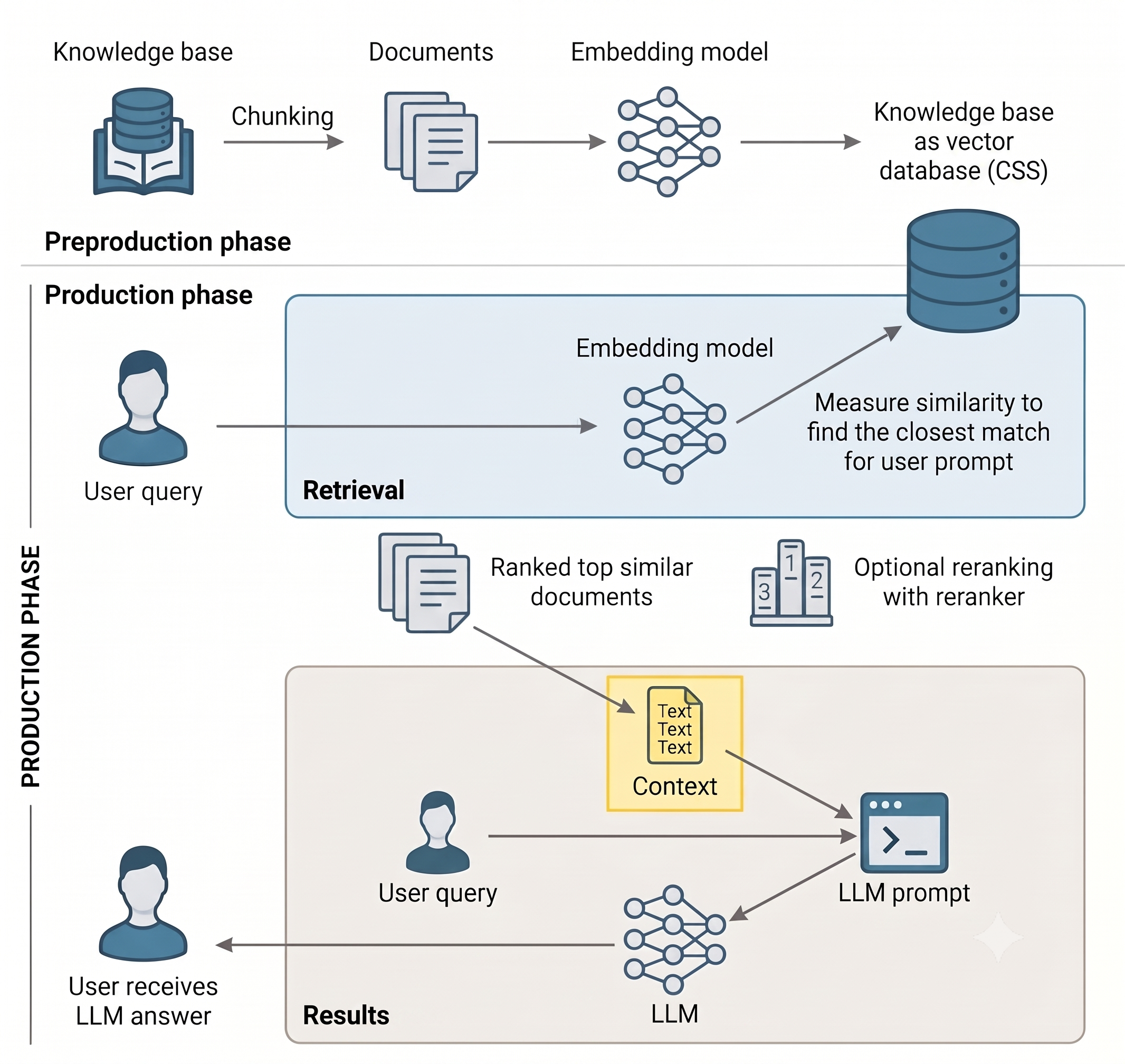
Cloudera Semantic Search integrates hybrid multimodal search functionality into the enterprise data estate. It serves as the retrieval foundation for autonomous AI agents and Retrieval-Augmented Generation (RAG) by transforming knowledge sources into searchable vector representations. This service maintains data gravity by enabling searches across internal documentation, support systems, and data lakehouses without transferring information outside the organization.
Common use cases
Vector search
Cloudera Semantic Search's vector search delivers a comprehensive vector database architecture designed to facilitate the development of high-performance artificial intelligence applications. By allowing the storage and querying of vector embeddings in conjunction with conventional datasets, it enables the seamless integration of semantic search, retrieval-augmented generation (RAG) frameworks, recommendation engines, and other advanced AI-driven solutions.
Lexical search
Lexical search, commonly referred to as keyword search, denotes an information retrieval mechanism that identifies pertinent documents by matching the exact terminology or phrases within a query against text indexed in a database.
For example,
GET movies/_search
{
"_source": "title",
"query": {
"bool": {
"must": [
{"match": {"title": "star wars"}}
],
"filter": [
{"range": {"year": {"gte": 1977, "lte": 1983}}}
]
}}}

Response
{
 "took": 17,
 "timed_out": false,
 "_shards": {
   "total": 1,
   "successful": 1,
   "skipped": 0,
   "failed": 0
 },
 "hits": {
   "total": {
     "value": 8,
     "relation": "eq"
   },
   "max_score": 3.9967866,
   "hits": [
     {
       "_index": "movies",
       "_id": "MFH5vqAB1whDbi5bhRYY",
       "_score": 3.9967866,
       "_source": {
         "title": "Star"
       }
     },
     {
       "_index": "movies",
       "_id": "uE_1vqAB1whDbi5bO8NV",
       "_score": 3.9951444,
       "_source": {
         "title": "Star Wars: Episode IV - A New Hope"
       }
     },
     {
    …………………
    …………………
AI search
Artificial intelligence-driven search optimizes workflows by automated embedding generation. Cloudera Semantic Search converts textual data into high-dimensional vector representations during both the indexing and query execution phases. Consequently, it constructs and indexes vector embeddings for documents, subsequently mapping query text into corresponding embeddings to retrieve and return the most pertinent results.
Application and infrastructure monitoring
Cloudera Semantic Search provides comprehensive observability capabilities designed for monitoring applications, infrastructure, and AI agents through a variety of integrated tools. It allows users to ingest observability data—transforming unstructured log data—and explore it using specialized applications such as Event Analytics, Application Analytics, Trace Analytics, and Metric Analytics.
Data analytics
OpenSearch Dashboards serves as the web-based user interface for Cloudera Semantic Search, enabling users to perform most API-driven tasks, explore and query data using various query languages such as Dashboards Query Language (DQL), SQL, and PPL, and build comprehensive data visualizations and interactive dashboards.