Creating your cluster
Once you have met the prerequisites, you are ready to create a managed and secured Streams Messaging cluster in Cloudera on cloud by using one of the prescriptive Streams Messaging cluster definitions.
-
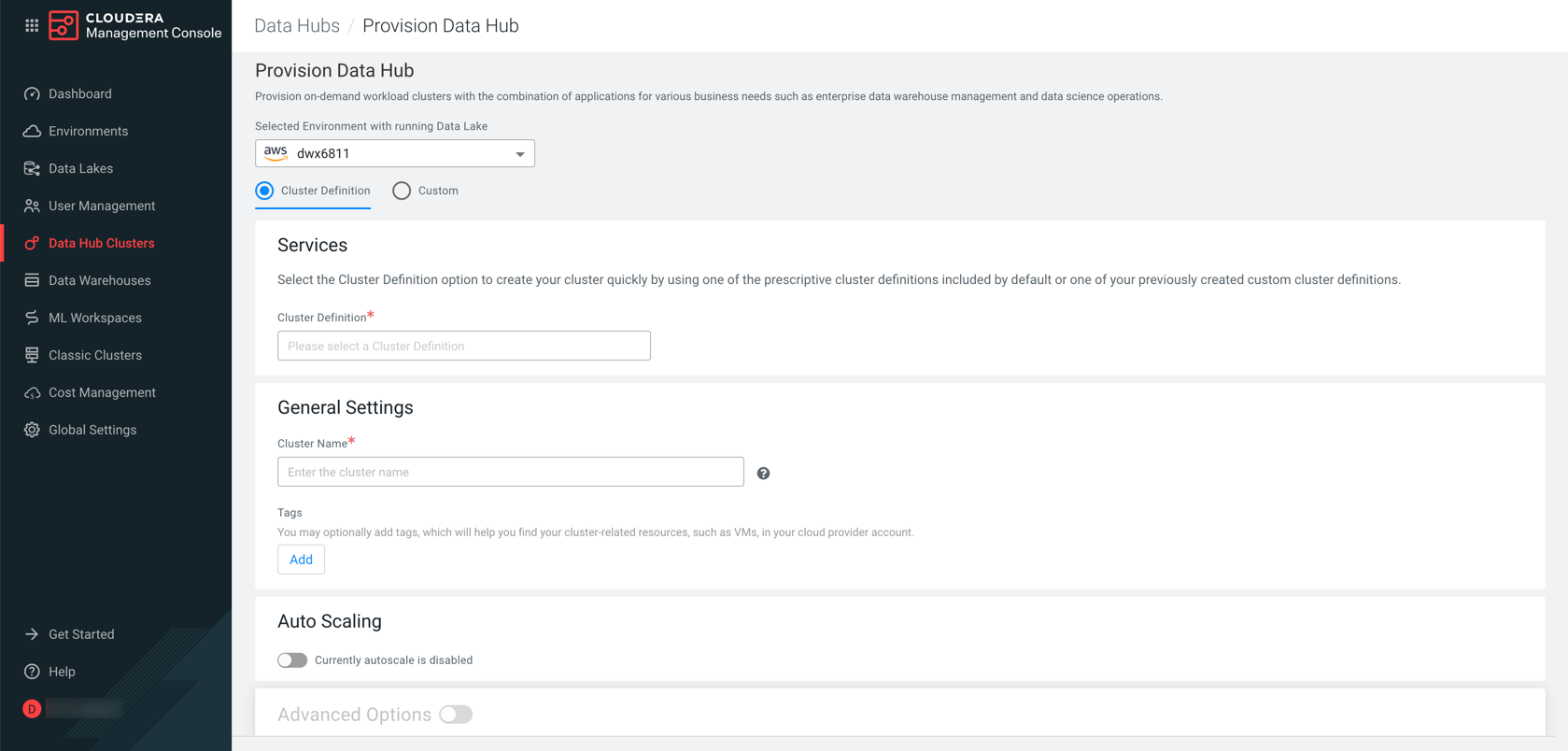
Click Create Data Hub.
The following page is displayed:
- Optional:
Add Kafka KRaft to your cluster.
KRaft nodes are not provisioned by default in any of the Streams Messaging cluster definitions. To run Kafka in KRaft mode, set the Instance Count of the Kraft Nodes host group to an odd number (Cloudera recommends a minimum of three nodes). Cluster provisioning fails if you specify an even number. Starting in Cloudera Runtime 7.3.2 SP1, you can scale KRaft nodes after cluster provisioning. For more information, see Scaling KRaft. ZooKeeper service instances are still deployed in KRaft mode and can be optionally deleted after the cluster is deployed.
- Go to .
-
Locate the Kraft Nodes host group and click
 to edit host group
details.
to edit host group
details.
- Set the Instance Count to at an odd number
-
Click
 to save your
changes.
to save your
changes.
- Optional:
Add Streams Replication Manager or Kafka Connect to Heavy Duty clusters.
Streams Replication Manager and Kafka Connect nodes are not provisioned by default when using the Streams Messaging Heavy Duty definition. If you are using this definition and want to have Streams Replication Manager, Kafka Connect, or both deployed in the cluster, set the Instance Count of the Srm Nodes or Connect Nodes host group to at least one.
-
Locate the appropriate host group and click to edit host group details.
-
Click to save your
changes.
-
Locate the appropriate host group and click
- If you have provisioned KRaft nodes in your cluster, you can optionally choose to remove ZooKeeper from your cluster. For more information, see Deleting ZooKeeper from Streams Messaging clusters.
- If you configured Attached Volume per Instances and the volume count is not identical for the Broker and Core_brokers host groups, continue with Configuring data directories for clusters with custom disk configurations.
- If you did not customize Attached Volume per Instances or do not want to remove ZooKeeper, continue with Give users access to your cluster.