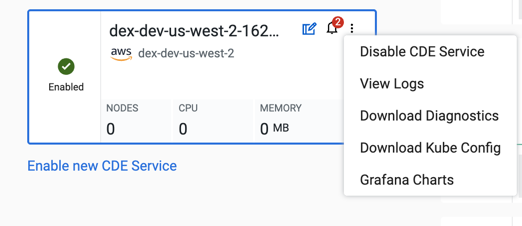
This section describes how to download a diagnostics bundle to troubleshoot a Cloudera Data Engineering Service using the Cloudera Data Engineering UI.
To troubleshoot issues with your Cloudera Data Engineering Service,
download the diagnostics bundles of log files. These diagnostics bundles, in the form of ZIP
files, are downloaded to your local machine. This is available on both AWS and Azure
environments.
Required Role: DEAdmin
After granting or revoking the role on the environment, run the Sync
Users to FreeIPA environment action.
-
On the Cloudera Data Engineering UI, click
Administration in the left navigation panel, and select the Cloudera Data Engineering Service for which you want to download a diagnostic
bundle.
-
In the selected Cloudera Data Engineering Service, click on the three-dot
menu, and select the Download Diagnostics option.
-
On the Diagnostics tab of the Service
Details, click the Generate Diagnostics Bundle
button.
The Generate Diagnostics Bundle dialog box
launches.
-
On the General Settings tab, set the time range and select the
log sources that you want to include.
On the General Settings tab, you can choose or set the
following options:
- Pre-defined Range: Select a specific time range of log files to generate from
the drop-down list, or you can choose a custom interval in the next option.
- Custom Range: Select the start and end time from the drop-down list to define
the specific time interval for the log files in the diagnostic bundle.
- Log Sources: Select All or any of the available categories of log files for
the different Services and virtual clusters by clicking the adjacent checkbox.
-
On the Advanced Settings tab, you can adjust the resources to
help prevent inaccurate resource allocation and potential Out-of-Memory (OOM) errors
during bundle generation for large environments.
-
Click Generate to generate the bundle.
-
When the diagnostics bundle is created, click Download.
When you extract the diagnostics bundle .gz file that you downloaded from Cloudera Data Engineering UI, you find the directories that contain service log
files and summary status.