Parameter groups
You can create groups of parameters that can be shared within a project. This allows you to disseminate common parameter values between several flow drafts and deployments, without the need of individually checking and manually updating them. When creating a flow deployment, creating a draft in Flow Designer, or managing a deployment, you may add shared parameters by editing a single parameter or importing parameters from a shared parameter group. You manage shared parameter groups in the Resources view of Cloudera Data Flow.
-
Open Cloudera Data Flow by clicking the
 Data Flow tile in the Cloudera sidebar.
-
Select the parameter group you want to interact with.
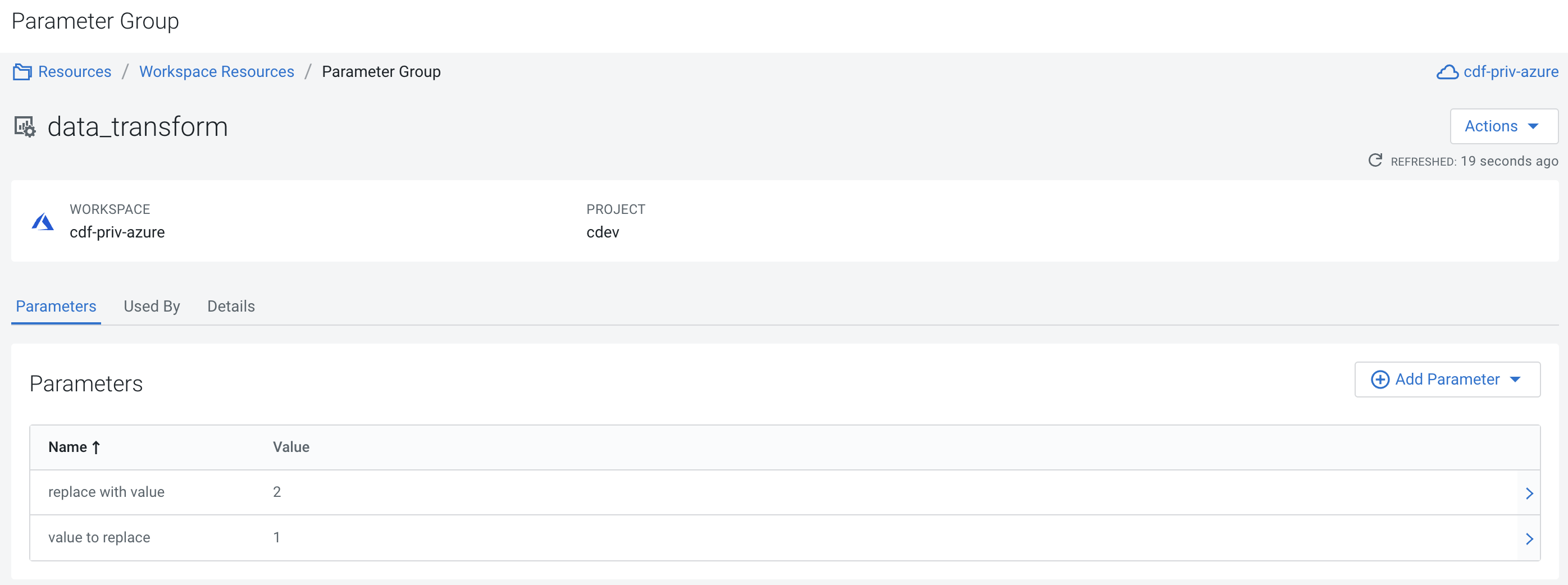
- To view the list of flow deployments and flow drafts using this parameter group, select the Used By tab. It is important to be aware of the flow deployments and flow drafts that are going to be affected by any change you make to a parameter group.
- To view or modify the Parameter Group Name and Description, select the Details tab.
Creating a parameter group
- Make sure that you have DFDeveloper permission to perform this task. For information on account and resource roles, see Cloudera Data Flow Authorization.
-
Click
 Create Parameter
Group.
Create Parameter
Group.
Adding parameters to a group
- Make sure that you have DFDeveloper permission to perform this task. For information on account and resource roles, see Cloudera Data Flow Authorization.
-
Click Add
Parameter > Add Parameter or Add
Parameter > Add Sensitive Parameter to add a sensitive parameter.
The parameter type (sensitive or non-sensitive) cannot be modified later.
-
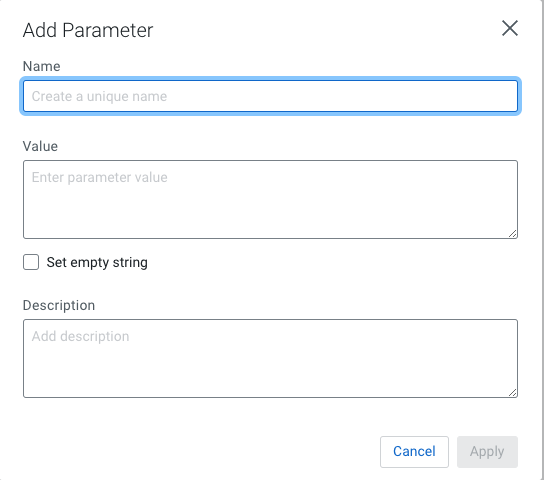
Provide the parameter Name, define a
Value (or select Set empty
string) and optionally provide a parameter
Description.
-
Click
 Apply Changes.
Modifying parameters in a parameter group
When you need to update connection strings, credentials, or other configuration values in a parameter group, you can modify the parameter value and description. Updating parameters in a central location helps you propagate changes to all flow drafts that use that parameter group without editing each flow individually.
- Make sure that you have DFDeveloper permission to perform this task. For information on account and resource roles, see Cloudera Data Flow Authorization.
-
Click
 > Open.
-
Click Apply Changes.
Deleting a parameter group
When a parameter group is no longer needed and is not used by any flow draft, you can delete it to keep your resources organized. Removing unused parameter groups helps you maintain a clean set of shared configurations and avoid confusion when managing flow deployments.
- Make sure that you have DFDeveloper permission to perform this task. For information on account and resource roles, see Cloudera Data Flow Authorization.
-
Click
> Open.
-
Click on the parameter card that you want to delete.
In the parameter details pane click
 Delete to delete the parameter from the
group.If the parameter group is not used by any flow draft, the Delete [parameter group name] modal opens. If the parameter group is in use by a flow draft, it cannot be deleted.
Delete to delete the parameter from the
group.If the parameter group is not used by any flow draft, the Delete [parameter group name] modal opens. If the parameter group is in use by a flow draft, it cannot be deleted. -
Click Apply Changes.
Importing a parameter group to a flow draft
When you want to reuse an existing parameter group in a flow draft, you can import it so that the flow can reference those parameters. Importing a parameter group helps you avoid redefining the same configuration values and ensures consistency across your flow drafts.
- Select the Parameter Group that you want to import to a flow draft.
-
Click
>
 Import to Flow Draft.
- In the Import to Flow Draft modal select the Flow Draft where you want to import the parameter group.
- Click Import.
Duplicating a parameter group
Learn how to duplicate parameter groups. Duplicating a parameter group allows you to reassign the newly created group to another project, or to customize it according to your needs without touching the original group.
- Select the Parameter Group that you want to import to duplicate.
-
Click
>
 Duplicate.
- In the Duplicate Parameter Group modal provide a Parameter Group Name and an optional Description.
- Click Duplicate.
Reassigning a parameter group to a different project
Learn how to reassign a parameter group to another project.
- Make sure that you have DFDeveloper permission to perform this task. For information on account and resource roles, see Cloudera Data Flow Authorization.
You cannot reassign a parameter group that is used by flow drafts. You have to remove the group from all flow drafts before you can reassign it to a different project.
-
Click Apply Changes.
Managing parameter groups using the CLI
Full lifecycle management of shared parameter groups using the CDP CLI is possible in Cloudera Data Flow.
- You have installed CDP CLI.
create-parameter-group — Create a new shared parameter group
describe-parameter-group — View details of a parameter group
list-parameter-groups — List parameter groups (filterable by project)
update-parameter-group — Modify an existing parameter group
delete-parameter-group — Remove a parameter group
duplicate-parameter-group — Clone an existing parameter group
upload-parameter-asset — Upload asset files to a parameter groupcdp df duplicate-parameter-group